




What are hip problems in infants?
A hip problem in infants is known as developmental dysplasia of the hip (DDH). It is when the ball of the hip joint isn’t formed properly and does not fit well in the socket. Often, this means that the hip joint is loose and prone to injury. DDH can lead to dislocation of the hip or other health issues.
Symptoms of hip problems in infants
Hip problems may not be easy to see at first. Most babies do not show symptoms. One sign to look for is if their hips don’t open well when you change their diaper. Once your child is walking, a limp may be a sign of DDH.
What causes hip problems in infants?
The exact cause of DDH is unknown. It is more common in:
- Breech births (in a bottom-first position before birth instead of a head-first position)
- First born
- Twins or multiple births
- Babies who are large in size
- Girls (their ligaments tend to be more flexible)
- Families with a history of DDH.
How are hip problems in infants diagnosed?
Usually, the doctor can feel if something is wrong. The doctor first checks your baby’s hips in the hospital after birth. They do this by gently pushing and pulling the baby’s thigh bones to see if they are loose in the hip socket. An ultrasound may be needed to get a picture of the hip. X-rays can be taken once your baby is 4 months old.
Hip problems may not be present at birth. They may become an issue as your baby’s body develops. The doctor will check your baby’s hips at each well-baby check-up. As your child grows, the doctor checks to see if your baby’s thighs spread apart easily.
Your doctor may recommend an ultrasound even if the physical exam of your baby is normal. Most doctors follow the recommendation to do this for infants who are breech or when there is a family history of DDH.
Can hip problems in infants be prevented or avoided?
DDH cannot be avoided since the cause is unknown. However, there are some things you can do to keep it from getting worse:
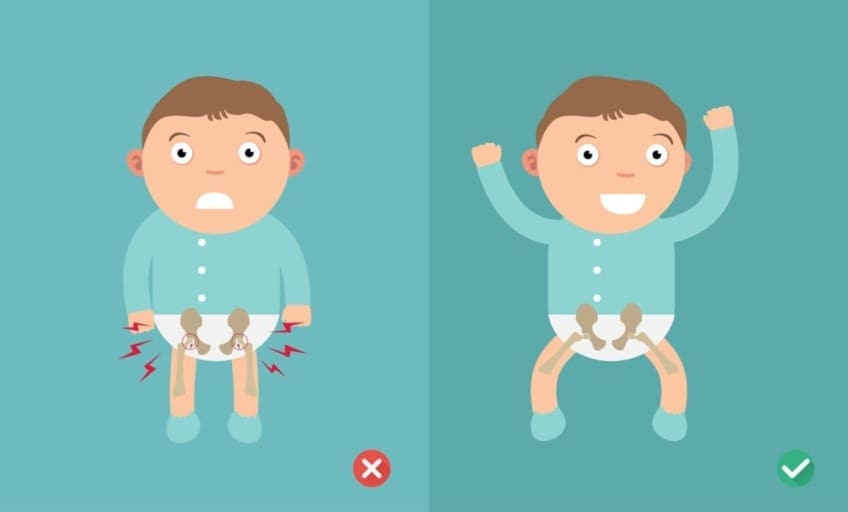
- Use a proper method to swaddle your baby. Do not wrap their legs too tight. Your baby should have room to move their hips and keep their joints loose.
- Buy products that protect your baby’s legs and hips. This includes baby seats, slings, swings, and carriers. Follow the instructions to use these products properly.
- Be careful when wearing your baby in a carrier. Your baby’s hips should be in a spread squat position. This means their hips are open and their knees are bent at the same height as or higher than their bottom. Their legs should be able to wrap around your torso.
- Tell your doctor if you, another child, or a relative has DHH. This increases the chance of your baby having DDH.
Treatment for hip problems in infants
Treatment may not be needed right away. Instead, the doctor will continue to check your baby’s hips to make sure they grow correctly. If the problem does not go away, gets worse, or is severe, the doctor likely will decide to treat the issue.
A soft brace, called a “Pavlik harness,” can treat most hip problems. This brace keeps your baby’s knees spread apart and bent up toward the chest. The doctor should check your baby’s hips the first few weeks to see if the hip is going into place and staying there. Once the hip is in place, your baby keeps wearing the brace for another 2 or 3 months. Your baby wears the brace day and night for about 3 to 6 months total.
About 1 in 20 babies needs more than a brace to fix a hip problem. Surgery is needed in more severe cases. A closed reduction surgery involves moving the hip joint back into place. An open reduction surgery involves removing or dislocating the hip joint. This allows the doctor to clean out the socket then align and reattach the hip joint correctly. After surgery, your baby may wear a cast and/or brace for several months to keep the hip in place.
Living with hip problems in infants
Treatment and ongoing monitoring should fix DDH. There is a chance of future recurring problems, such as dislocation. Talk to your doctor about the benefits and risks of treatment, as well as possible related issues. You may benefit from joining a support group of other parents who have dealt with the same problem.
Questions to ask your doctor
- How severe is my child’s hip problem?
- How often do you see this condition in other children?
- Will my child need to see a specialist?
- What is the best form of treatment and how effective is it?
- What are the benefits and risks of surgery?
- Will my child need to wear a brace or cast? If so, for how long?
- Is my child at risk for other hip problems later in life?

Copyright © American Academy of Family Physicians
This information provides a general overview and may not apply to everyone. Talk to your family doctor to find out if this information applies to you and to get more information on this subject.