




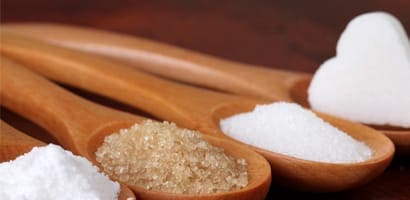
El azúcar es un carbohidrato simple que proporciona calorías para que su cuerpo las utilice como energía. Hay dos tipos principales de azúcar.
El azúcar natural se encuentra en alimentos integrales, no procesados. Estos incluyen frutas, verduras, lácteos y algunos cereales. La fructosa es un azúcar natural que se encuentra en la fruta. La lactosa es un azúcar natural que se encuentra en los productos lácteos de origen animal.
El azúcar añadido se encuentra en alimentos y bebidas procesados. También incluye el azúcar que usted le agrega a los alimentos en casa. El azúcar añadido proporciona poco o ningún valor nutricional. Se utiliza por diferentes motivos, como por ejemplo:
- Para mantener frescos los productos horneados durante más tiempo.
- Para evitar que las jaleas y mermeladas se echen a perder.
- Para ayudar a la fermentación de panes y alcohol.
- Para mejorar el sabor, color o textura de alimentos y bebidas.
Los principales alimentos que contienen azúcar añadido incluyen:
- Caramelos
- Pasteles
- Galletas dulces
- Tartas y cobblers (‘zapateros’)
- Panecillos dulces, repostería y donas
- Postres con lácteos, como helado y yogur.
- Bebidas azucaradas, como bebidas gaseosas, bebidas deportivas, bebidas energéticas y jugos.
A muchos estadounidenses les encanta el azúcar, y demasiada. Sin embargo, usted debe limitar la cantidad de azúcar añadida a no más del 10 % del total de sus calorías diarias. Eso es tan solo 200 calorías diarias basadas en una dieta de 2,000 calorías por día. Eso se traduce en no más de 50 gramos de azúcar por día.
El camino hacia una mejor salud
El comer o beber demasiada azúcar añadida, puede causar problemas de salud. Estos incluyen:
- Caries dentales
- Obesidad
- Diabetes tipo 2
- Enfermedad cardíaca
- Altos niveles de triglicéridos
- Aumento en los niveles de colesterol de lipoproteínas de baja densidad (LDL, o «malo»)
- Bajos niveles de colesterol de lipoproteínas de alta densidad (HDL o «buena»)
Las personas que consumen muchos alimentos y bebidas que contienen azúcar añadido es menos probable que coman y beban opciones más saludables. Por ejemplo, la leche contiene azúcar natural pero también proporciona calcio, proteínas y vitaminas que ayudan a que su cuerpo funcione de manera adecuada. Las bebidas azucaradas contienen azúcar añadida y proporcionan poco o ningún valor nutricional a su cuerpo.
Su cuerpo necesita cierta cantidad de calorías diarias para obtener energía. Piense en esto como su objetivo de ingesta calórica diaria. Su objetivo depende de su edad, altura, peso y nivel de actividad. La mayoría de las calorías que come y bebe le deben proporcionar nutrientes. Dado que los azúcares añadidos aportan poco valor nutricional, se les llama «calorías vacías». Si usted come o bebe demasiadas calorías vacías corre el riesgo de aumentar de peso.
Aspectos a tener en cuenta
Existen muchas formas de limitar o evitar el azúcar añadido en su dieta.
- Elija alimentos saludables para el corazón, como frutas, verduras, proteínas magras y cereales integrales para las comidas y los refrigerios.
- Elimine los dulces, los productos horneados y los postres con lácteos.
- Opte por beber agua en lugar de las bebidas azucaradas. Una lata de 12 onzas de refresco regular (no dietético) contiene aproximadamente 130 calorías y 8 o más cucharaditas de azúcar. Además, elimine el jugo, el cual está cargado de calorías. El jugo no es un sustituto de las frutas y vegetales reales.
- Elimine los alimentos procesados. Estos tienen un alto contenido de azúcar añadido y sodio.
- Busque recetas que utilicen menos azúcar al cocinar u hornear.
Es importante leer la etiqueta de información nutricional al comprar alimentos. Verifique la cantidad de azúcar en un producto. Un gramo de azúcar equivale a 4 calorías y 4 gramos equivale a 1 cucharadita de azúcar. Por ejemplo, si una etiqueta dice 40 gramos de azúcar, está consumiendo 160 calorías y 10 cucharaditas de azúcar por porción de ese alimento. ¡Eso es mucho! Entonces, cuanto menor sea la cantidad de azúcares añadidos, mejor. Como regla general, los alimentos con menos del 5 % de azúcar añadido son una buena elección. Los alimentos con más del 20 % de azúcares añadidos deben evitarse.
La etiqueta de información nutricional también le indica los ingredientes de los alimentos. El azúcar puede tener muchos nombres. Algunos ejemplos incluyen:
- Jarabe (de muchos tipos diferentes)
- Azúcar morena
- Miel
- Melaza
- Concentrados de jugo de frutas
- Dextrosa
- Fructosa
- Glucosa
- Sacarosa
La Academia Estadounidense de Médicos de Familia apoya la imposición de impuestos a las bebidas azucaradas con el propósito de reducir el consumo excesivo como método tanto para mejorar la salud del público como para combatir la epidemia de obesidad.
Preguntas para hacerle a su médico
- ¿Cuántas calorías debo comer al día?
- ¿Cuánta azúcar añadida es demasiado?
- ¿Existen formas de sustituir el azúcar natural por azúcar añadida al cocinar u hornear?
- ¿Qué debo comer si quiero un bocadillo dulce?
Recursos
Institutos Nacionales de Salud, MedlinePlus: Edulcorantes – Azúcares
Última Versión Actualizada:
Este artículo fue contribuido por El Personal Editorial


Copyright © American Academy of Family Physicians
Esta información proporciona una visión general y puede que no se aplique a todos. Hable con su médico de familia para averiguar si esta información se aplica a usted y para obtener más información sobre este tema.