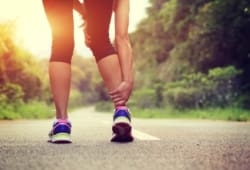
Sever's disease occurs in children when the growth plate (which is the growing part of the heel) is injured. The foot is one of the first body parts to grow to full size. This usually occurs in early puberty. During this time, bones often grow faster than muscles and tendons. As a result, muscles and tendons become tight. The heel area is less flexible. During weight-bearing activity (activity performed while standing), the tight heel tendons may put too much pressure at the back of the heel (where the Achilles tendon attaches). This can injure the heel and cause Sever's disease.
Sever's Disease
When is my child most at risk for Sever's disease?
How do I know if my child's heel pain is caused by Sever's disease?
How is Sever's disease treated?
Will stretching exercises help?
When can my child play sports again?
Are there any problems linked with Sever's disease?
Can Sever's disease be prevented?
See Also:
Sever's Disease: A Common Cause of Heel Pain
What is Sever's disease?
When is my child most at risk for Sever's disease?
Your child is most at risk for this condition when he or she is in the early part of the growth spurt in early puberty. Sever's disease is most common in physically active girls 8 to 10 years old and in physically active boys 10 to 12 years old. Soccer players and gymnasts often get Sever's disease, but children who do any running or jumping activity may also be at an increased risk. Sever's disease rarely occurs in older teenagers because the back of the heel has typically finished growing by the age of 15.
How do I know if my child's heel pain is caused by Sever's disease?
In Sever's disease, heel pain can be in one or both heels. It usually starts after a child begins a new sports season or a new sport. Your child may walk with a limp. The pain may increase when he or she runs or jumps. He or she may have a tendency to tiptoe. Your child's heel may hurt if you squeeze both sides toward the very back. This is called the squeeze test. Your doctor may also find that your child's heel tendons have become tight.
How is Sever's disease treated?
First, your child should cut down or stop any activity that causes heel pain. Apply ice to the injured heel for 20 minutes 3 times a day. If your child has a high arch, flat feet or bowed legs, your doctor may recommend orthotics, arch supports or heel cups. Your child should never go barefoot.
If your child has severe heel pain, medicines such as acetaminophen (one brand name: Tylenol) or ibuprofen (some brand names: Advil, Motrin, Nuprin) may help.
Will stretching exercises help?
Yes, stretching exercises can help. It is important that your child performs exercises to stretch the hamstring and calf muscles, and the tendons on the back of the leg (see pictures 1, 2 and 3). The child should do these stretches 2 or 3 times a day. Each stretch should be held for about 20 seconds. Both legs should be stretched, even if the pain is only in 1 heel.
Your child also needs to do exercises to strengthen the muscles on the front of the shin (see picture 4). To do this, your child should sit on the floor, keeping his or her hurt leg straight. One end of a bungee cord or piece of rubber tubing is hooked around a table leg. The other end is hitched around the child's toes. The child then scoots back just far enough to stretch the cord. Next, the child slowly bends the foot toward his or her body. When the child cannot bend the foot any closer, he or she slowly points the foot in the opposite direction (toward the table). This exercise (15 repetitions of "foot curling") should be done about 3 times. The child should do this exercise routine a few times daily.
1. Calf stretch.
2. Heel cord (Achilles tendon) stretch.
3. Hamstring stretch.
4. Strengthening exercise using a bungee cord or rubber tubing.
When can my child play sports again?
With proper care, your child should feel better within 2 weeks to 2 months. Your child can start playing sports again only when the heel pain is gone. Your doctor will let you know when physical activity is safe.
Are there any problems linked with Sever's disease?
No long-term problems have been linked with Sever's disease. However, call your doctor if your child's heel pain does not get better with treatment, gets worse or if you notice changes in skin color or swelling.
Can Sever's disease be prevented?
Sever's disease may be prevented by maintaining good flexibility while your child is growing. The stretching exercises pictured here can lower your child's risk for injuries during the growth spurt. Talk with your doctor for more advice. Good-quality shoes with firm support and a shock-absorbent sole will help. Your child should avoid excessive running on hard surfaces.
If your child has already recovered from Sever's disease, stretching and putting ice on the heel after activity will help keep your child from developing this condition again.
More Information
- Exercising Your Finger After an Injury
- Mallet Finger
- Eye Injuries in Sports
- Ankle Sprains
- Knee Braces
- Joint and Soft Tissue Injections
- Shoulder Pain
- Shoulder Instability
- Rotator Cuff Exercises
- Plantar Fasciitis & Heel Pain
- Adhesive Capsulitis
- Hives & Exercise
- Patellofemoral Pain
- Concussion in Sports
- Burners
- High-Altitude Illness
Source
Written by familydoctor.org editorial staff.
American Academy of Family Physicians
Reviewed/Updated: 04/08
Created: 09/00
Copyright © 2000-2008 American Academy of Family Physicians
|This article provides a general overview on this topic and may not apply to everyone. To find out if this article applies to you and to get more information on this subject, talk to your family doctor.
For private, noncommercial use only.
Home | Privacy Policy | Contact Us | About This Site | What's New |
|This article provides a general overview on this topic and may not apply to everyone. To find out if this article applies to you and to get more information on this subject, talk to your family doctor.
For private, noncommercial use only.
Home | Privacy Policy | Contact Us | About This Site | What's New |