





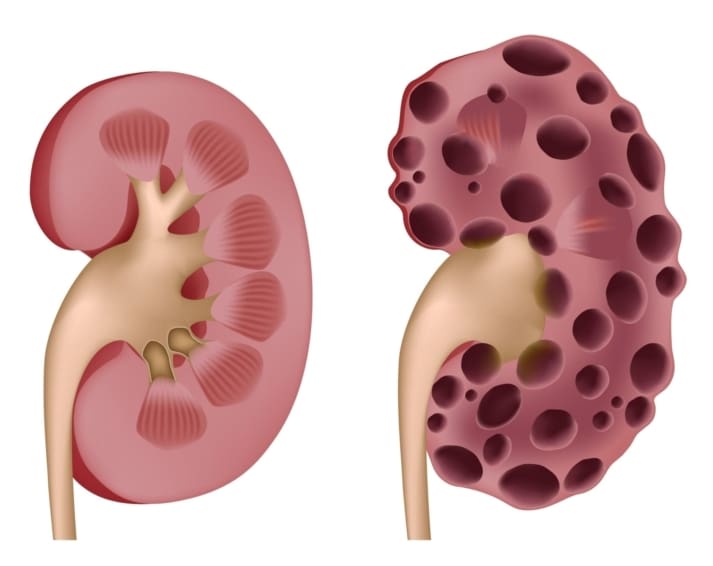
What are kidney cysts?
The kidneys remove waste from your blood. They do this by filtering the blood and making urine. As people get older, sacs filled with fluid can form in the kidneys. These sacs are called “cysts.” They are usually small, oval or round thin-walled sacs with watery fluid in them.
Kidney cysts are almost always benign (not cancerous). Usually, the cysts don’t cause any problems. In fact, people can go through life without even knowing that they have them.
Some people have kidney cysts caused by an inherited disease called polycystic kidney disease (PKD). This disease can cause symptoms such as high blood pressure, pain in the back and side, blood in the urine, or frequent kidney infections. Not all people who have PKD will have these symptoms.
How common are kidney cysts?
Up to 50 percent of people older than 50 years of age have kidney cysts.
Symptoms of kidney cysts
If you have kidney cysts, you may have these symptoms:
- Pain on your side between your ribs and your hip.
- Pain in your belly or back.
- A fever.
- Frequent urination.
- Blood in your urine or dark urine.
If you’re having any of these symptoms, you should contact your doctor.
What causes cysts on the kidneys?
If your kidney cysts are caused by PKD, then they are inherited. This means you have them because they run in your family. For most people, though, this is not the case. Doctors aren’t sure why the cysts form for them. It could be that the kidney surface weakens over time. This could explain why cysts on the kidneys are most common in people who are age 50 and older.
How are kidney cysts diagnosed?
Almost all kidney cysts are found on imaging tests that create a picture of your internal organs. These tests include ultrasound, computerized tomography (CT), or magnetic resonance imaging (MRI) scans. Sometimes kidney cysts are found when one of these tests is performed for another reason.
Can kidney cysts be prevented or avoided?
Because doctors aren’t sure what causes them, kidney cysts cannot be prevented or avoided.
Kidney cysts treatment
If you’re not having any of the symptoms listed in the “Symptoms” section, and your kidney cyst is small, you may not need any treatment. Your doctor might want to check the cyst again with a CT scan in 6 to 12 months.
If you start having problems, your doctor might want you to have a CT or MRI scan of your kidney to see if the cyst is growing.
If the cyst on your kidney is large or if it contains calcifications (hard, stony pieces) or dense tissue, you might need to have CT scans every so often. This allows your doctor to watch for changes in the cyst.
If your cyst is blocking blood flow or urine flow, your doctor may have to treat it. He or she may use a procedure called sclerotherapy. During sclerotherapy, your doctor will use a long needle to drain the cyst. He or she will then fill the cyst with an alcohol solution to harden kidney tissue.
Will I need surgery to remove a kidney cyst?
If your cyst isn’t causing any problems, it probably won’t need to be removed. If it is getting larger or if it’s causing problems, your doctor may send you to a urologist (a doctor who has special training in kidney problems).
Living with kidney cysts
If you are over 50 years old, there is a good chance you have cysts on your kidneys and don’t realize it. You may never realize it because you may never have symptoms. And most kidney cysts do not cause any problems.
If you do have symptoms (back or belly pain, blood in your urine, etc.), see your doctor. He or she can advise you on a treatment or ways to help relieve your symptoms.
Questions to ask your doctor
- What treatment is best for me?
- Is there a cause for my kidney cysts?
- Are there any medicines that I should take?
- Will I need surgery?
- Should I see a urologist?
- Are there any complications I should watch out for?
- Will my kidney cyst get bigger?
- How often should I come back for follow-up visits?

Copyright © American Academy of Family Physicians
This information provides a general overview and may not apply to everyone. Talk to your family doctor to find out if this information applies to you and to get more information on this subject.